Powered by Blogger.
Showing posts with label Christianity. Show all posts

Saturday, 5 September 2026

A Christian Responsibility


Twenty-third Sunday in Ordinary Time

06 September 2026

 
First Reading: Ezekiel 33:7-9
Responsorial Psalm: Psalm 95:1-2, 6-7, 8-9
Second Reading: Romans 13:8-10
Gospel: Matthew 18:15-20
 
Reflection
By: Jose Paulo Gonzales
 
“To err is human, to forgive, divine.” Credited to Alexander Pope, I would often see this sticker plastered across many rear windshield or bumper – a thoughtful reminder of how noble it is to forgive, but on the basic level, how common it is for all of us to make a mistake.

As a child being eased into the world, I would often get reminded to pay elders my basic respects: “O, magmano ka” (when it was still the norm especially within Filipino circles). In the household, we have probably seen the youngest member of the family doodling their masterpiece on the wall; a young teen blasting their music louder than others in the room can tolerate; or even the most seasoned of parents leaving cabinet doors open. All of us have our share of faults, enough that it has become customary to say “sorry” to acknowledge what we did and audibly express our contrition; but it is a different matter when the person who makes a mistake does not know what happened (i.e. ignorance). Depending on the severity of the fault, the aggrieved may simply choose to go on his or her way; but what do we do when the wrongdoer, after seeing something amiss to which they had some sizable contribution, ‘maintains,’ especially in earnest, that there is no harm done? Further, what do we do when the person repeats the same mistake?

Both the First Reading and the Gospel for today provide inquiry into the matter: when we receive God’s revelation, it is on ourselves to relay what God shared, so that others know what they need to do to participate, especially if there is something for which they must atone. If they do not want to repent for the wrong made known, the guilt rests upon their hands, and is extinguished from us, for we have done our part in reminding (although perhaps a certain sense of compassion would stretch some to remind further, again and again, very insistently; after all, if we must forgive others seventy seven times, should we not remind others just the same—as an act of love—so they can be forgiven?) Scripture is clear: our guilt is absolved when we admonish; another’s, if he or she repents; nevertheless, it is love itself that decides to go the extra measure: “Regardless of whether I am already free of guilt—what can I do to help the other person be forgiven?” This perhaps is when we become more Christlike—when we love, as said in the Second Reading. The Gospel shares with us more crucial insights into how to confront a wrongdoer. Telling someone his or her fault alone with only yourselves present is like today’s “Praise in public, criticize in private.” Letting confrontation remain privately between or among only those concerned addresses the issue while protecting the dignity of the parties involved; but in cases where the issue cannot anymore be resolved privately for the repercussions are wide-reaching, more so if the wrongdoer willfully does not admit to the mistake, the testimony of two to three witnesses establishes the more convincing claim of truth (in cases where the statements of more people hold a higher truth value). The solidarity exemplified here gives mention to two things: the importance of community—the Church—in maintaining discipline and how discipline, best handled privately with discretion, is ultimately a common social responsibility. After all, are we not our brothers’ and sisters’ keepers? Finally, it is wonderfully heralded in the Gospel: the two, three, or many believers helping us make sure that we remain in God’s discipline and love resemble the same community God accompanies fondly in prayer. This tells us: we must always strive to keep the quality of our bonds especially as the Church, and the [best] way to live harmoniously together is through love… through God, Godself.

Prayer

God, thank You for Your Presence and for reminding us how important it is to preserve our connection as Your Church. May we all do our share in keeping the Church alive and extend Her reach especially to those who have yet to encounter Her closely.

We also commend to Your loving hands those ravaged by the monsoon rains and flooding, the current state of political affairs, and the rise in incidents of violence among schools in the Philippines, those devastated by flashfloods in China-Tibet and Nepal, those in Southeast Asia who sustain the diffusion of toxic fumes from peatland fires, and those around the world who are suffering the effects of war.

These, we ask, in Jesus’ most holy Name, Amen.

Saturday, 18 April 2015

Do You Often Doubt What You See?

  Fourth Sunday of Easter
          April 19, 2015

First Reading: Acts 3:13-15, 17-19

Peter said to the people:

“The God of Abraham, the God of Isaac, and the God of Jacob, the God of our fathers, has glorified his servant Jesus, whom you handed over and denied in Pilate’s presence when he had decided to release him. You denied the Holy and Righteous One and asked that a murderer be released to you. The author of life you put to death, but God raised him from the dead; of this we are witnesses. Now I know, brothers, that you acted out of ignorance, just as your leaders did; but God has thus brought to fulfilment what he had announced beforehand through the mouth of all the prophets, that his Christ would suffer. Repent, therefore, and be converted, that your sins may be wiped away.”

Responsorial Psalm: Psalms 4:2, 4, 7-8, 9

Second Reading: 1 John 2:1-5A

My children, I am writing this to you so that you may not commit sin. But if anyone does sin, we have an Advocate with the Father, Jesus Christ the righteous one. He is expiation for our sins, and not for our sins only but for those of the whole world. The way we may be sure that we know him is to keep his commandments. Those who say, “I know him,” but do not keep his commandments are liars, and the truth is not in them. But whoever keeps his word, the love of God is truly perfected in him.

Gospel: Luke 24:35-48

The two disciples recounted what had taken place on the way, and how Jesus was made known to them  in the breaking of bread. While they were still speaking about this, he stood in their midst and said to them, “Peace be with you.” But they were startled and terrified and thought that they were seeing a ghost. Then he said to them, “Why are you troubled? And why do questions arise in your hearts?

Look at my hands and my feet, that it is I myself. Touch me and see, because a ghost does not have flesh and bones as you can see I have.” And as he said this,he showed them his hands and his feet. While they were still incredulous for joy and were amazed, he asked them, “Have you anything here to eat?” They gave him a piece of baked fish;  he took it and ate it in front of them.


He said to them, “These are my words that I spoke to you while I was still with you, that everything written about me in the law of Moses and in the prophets and psalms must be fulfilled.” Then he opened their minds to understand the Scriptures. And he said to them, “Thus it is written that the Christ would suffer and rise from the dead on the third day and that repentance, for the forgiveness of sins, would be preached in his name to all the nations, beginning from Jerusalem. You are witnesses of these things.”

Reflection
By Bernard Borja

An atheist was taking a walk through the woods, admiring all that evolution had created.

“What majestic trees! What powerful rivers! What beautiful animals!” he said to himself. As he was walking along the river, he heard a rustling in the bushes behind him. When he turned to see what the cause was, he saw a 7-foot grizzly charging right towards him. He ran as fast as he could. He looked over his shoulder and saw that the bear was closing, He ran even faster, crying in fear. He looked over his shoulder again, and the bear was even closer. His heart was pounding and he tried to run even faster. He tripped and fell on the ground. He rolled over to pick himself up, but saw the bear right on top of him, reaching for him with its left paw and raising its right paw to strike him.

At that moment, the atheist cried out “Oh my God!!!” Time stopped. The bear froze. The forest was silent. Even the river stopped moving.

As a bright light shone upon the man, a voice came out of the sky, “You deny my existence for all of these years, teach others I don’t exist, and even credit creation to a cosmic accident. Do you expect me to help you out of this predicament? Am I to count you as a believer?”

The atheist looked directly into the light “It would be insincere of me to suddenly ask You to treat me as Christian now, but perhaps could you make the bear a Christian?”

“Very well,” said the voice. The light went out. The river ran again. And the sounds of the forest resumed.

And then the bear dropped its right paw, brought both paws together, bowed its head and spoke: “Lord, for what I am about to receive, I am truly thankful.”

---

I came across that story online and it got me thinking, how often do we believe in something that is really good and beautiful? Or to what extent do we allow ourselves to believe?

I remember what one of my mentors said during one of his talks, “God has been giving us guidance already. He has been giving us directions already. But we’re not hearing it, we’re not even following it, because we lack trust.”

The disciples have been given signs already beginning from the Scriptures up to the revealing of the resurrected Christ. They also have the first-hand experience of the ministry of Jesus. There were also two disciples who had confirmed that Jesus was raised and spent time with them during the walk to Emmaus. But how come they still doubt The One who appeared to them as real?

The Gospel reminds us how much we have been given signs for us to believe. But like the atheist in the story, we block our hearts from believing what has been told to us beforehand. We’ve already been seeing signs through the majestic, powerful, and beautiful things around us. But sometimes, we choose to believe in something else rooting in a theory of “just a mere accident”.


But despite of our unbelieving, God is always there to pursue us to open our minds. We just need to let our hearts be open and allow Him to speak to us. In all the wonders that we see and experience, we are all witnesses to God’s love. And Jesus Christ reveals Himself to us so that we may share the same love to everyone.

Prayer

Dear Lord, thank You for opening our hearts and minds to bring us closer to You. We feel Your presence and Your loving embrace because of the wonderful things You created for us. Grant us the grace that we may bring the same love to those who are afraid to believe, so that we may share with Jesus Christ Your Son, the fulfilment of Your kingdom here on earth. Amen.

Thursday, 10 January 2013

The Right Attitude

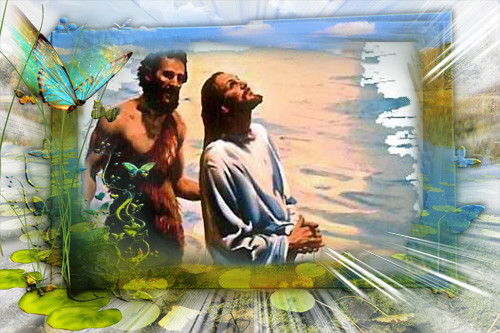
Feast of the Baptismof the Lord
January 13, 2013

 " Thou art my beloved Son; with thee I am well pleased. "


First Reading: Isaiah 42:1-4, 6-7

Behold my servant, whom I uphold, my chosen, in whom my soul delights; I have put my Spirit upon him, he will bring forth justice to the nations He will not cry or lift up his voice, or make it heard in the street; a bruised reed he will not break, and a dimly burning wick he will not quench; he will faithfully bring forth justice. He will not fail or be discouraged till he has established justice in the earth; and the coastlands wait for his law. "I am the LORD, I have called you in righteousness, I have taken you by the hand and kept you; I have given you as a covenant to the people, a light to the nations, to open the eyes that are blind, to bring out the prisoners from the dungeon, from the prison those who sit in darkness.

Psalm: Psalm 29:1-4, 3, 9-10

Second Reading: Acts 10: 34-38

And Peter opened his mouth and said: "Truly I perceive that God shows no partiality, but in every nation any one who fears him and does what is right is acceptable to him. You know the word which he sent to Israel, preaching good news of peace by Jesus Christ (he is Lord of all), the word which was proclaimed throughout all Judea, beginning from Galilee after the baptism which John preached: how God anointed Jesus of Nazareth with the Holy Spirit and with power; how he went about doing good and healing all that were oppressed by the devil, for God was with him.

Gospel: Luke 3:15-16, 21-22

As the people were in expectation, and all men questioned in their hearts concerning John, whether perhaps he were the Christ, John answered them all, "I baptize you with water; but he who is mightier than I is coming, the thong of whose sandals I am not worthy to untie; he will baptize you with the Holy Spirit and with fire. Now when all the people were baptized, and when Jesus also had been baptized and was praying, the heaven was opened, and the Holy Spirit descended upon him in bodily form, as a dove, and a voice came from heaven, "You are my beloved Son; with you I am well pleased."

Reflection
By Pietro S. Albano

John's baptism signified repentance. It was an act that he called people to do as part of changing their ways in preparation for the Coming Savior.  It was a shock then for John (as well as for us later on) to find out that Jesus also came to be baptized. He is all-holy so there is really no need for Him to be baptized, isn't it? And yet, according to some commentaries, Jesus' attitude of humility, of being identified with sinners, is the right attitude to approach God. In the subsequent chapters of the Gospels, one could see this attitude of Jesus till the very end of his earthly life.

Though we were still babies when we were baptized, our parents and godparents saw to it that we become part of God's big family. And as we grew up, we have received instruction from our elders, the school, the parish, etc. about our faith, about Jesus Himself.  Our learning and living as Christians is a continuous process that would only end when God finally calls us to our true home.  As we continue our journey of faith, let's keep our eyes fixed on Jesus. Sometimes, we're tempted to become complacent or conceited as Christians.  We care less our how we can spread our faith to others. "Why bother when almost everyone in the Philippines is Catholic?" we might say.  Or "I am better than those people in this or that religion because I belong to the true one." We can sometimes be choosy too with people we would like to mingle or deal with in the parish or any other community. Jesus wasn't complacent, conceited, or choosy. Why should we?

Let's therefore follow Jesus' way of life, His attitude of humble obdedience to the Father's will so that we too can hear those beautiful words: "You are my beloved son/daughter; with you I am well pleased."

Prayer

Lord Jesus, thank You for humbly sharing Your life with me in baptism. May I always do my best in sharing this with others for they too are our brothers and sisters.  Amen.
 

Thursday, 16 September 2010

Tool or Master?


25th Sunday in Ordinary Time
19 September 2010


Come, let us rejoice in the Lord: let us acclaim God our salvation, alleluia.


First reading Amos 8:4-7
Listen to this, you who trample on the needy
and try to suppress the poor people of the country,
you who say, ‘When will New Moon be over
so that we can sell our corn,
and sabbath, so that we can market our wheat?
Then by lowering the bushel, raising the shekel,
by swindling and tampering with the scales,
we can buy up the poor for money,
and the needy for a pair of sandals,
and get a price even for the sweepings of the wheat.’
The Lord swears it by the pride of Jacob,
‘Never will I forget a single thing you have done.’

Psalm: Psalm 112:1-2,4-8

Second reading 1 Timothy 2:1-8
My advice is that, first of all, there should be prayers offered for everyone – petitions, intercessions and thanksgiving – and especially for kings and others in authority, so that we may be able to live religious and reverent lives in peace and quiet. To do this is right, and will please God our saviour: he wants everyone to be saved and reach full knowledge of the truth. For there is only one God, and there is only one mediator between God and mankind, himself a man, Christ Jesus, who sacrificed himself as a ransom for them all. He is the evidence of this, sent at the appointed time, and I have been named a herald and apostle of it and – I am telling the truth and no lie – a teacher of the faith and the truth to the pagans.
In every place, then, I want the men to lift their hands up reverently in prayer, with no anger or argument

Gospel Luke 16:1-13
Jesus said to his disciples, ‘There was a rich man and he had a steward denounced to him for being wasteful with his property. He called for the man and said, “What is this I hear about you? Draw me up an account of your stewardship because you are not to be my steward any longer.” Then the steward said to himself, “Now that my master is taking the stewardship from me, what am I to do? Dig? I am not strong enough. Go begging? I should be too ashamed. Ah, I know what I will do to make sure that when I am dismissed from office there will be some to welcome me into their homes.”
Then he called his master’s debtors one by one. To the first he said, “How much do you owe my master?” “One hundred measures of oil” was the reply. The steward said, “Here, take your bond; sit down straight away and write fifty.” To another he said, “And you, sir, how much do you owe?” “One hundred measures of wheat” was the reply. The steward said, “Here, take your bond and write eighty.”
‘The master praised the dishonest steward for his astuteness. For the children of this world are more astute in dealing with their own kind than are the children of light.
‘And so I tell you this: use money, tainted as it is, to win you friends, and thus make sure that when it fails you, they will welcome you into the tents of eternity. The man who can be trusted in little things can be trusted in great; the man who is dishonest in little things will be dishonest in great. If then you cannot be trusted with money, that tainted thing, who will trust you with genuine riches? And if you cannot be trusted with what is not yours, who will give you what is your very own?
‘No servant can be the slave of two masters: he will either hate the first and love the second, or treat the first with respect and the second with scorn. You cannot be the slave both of God and of money.’

Reflection
By Pam Manzano

Money was tight for John Wesley. When he began his ministry in the 1700s, he had to budget to survive. After making calculations, he determined he would need about £40 (equivalent to roughly Php 2,700) to survive. Because there was little inflation during that time, John stayed on that yearly budget for the rest of his life. When he first made that decision, his annual income was about £44 enabling him to give away £4 that very first year.

When he became a famous minister and after he had written many books, his income often exceeded £2,000 per annum. But John still held on his budget and lived on £40. All the rest of the money was given to those who are neglected and poor or the charities who would help him tell others about God’s love.

John Wesley who started the Methodist Church decided at an early age that money would be his servant, not his master.

Money is a tool. It is a great resource when put to right use but is evil when we allow it to corrupt our minds. As 1 Timothy 6:10 aptly shares that the love of money is the root of all evil, we should not fail in letting money be a way for the evil to let us do things that will separate us from God’s love.

Possessions are a responsibility. What we have at the moment are things lent to us by the Great Provider. Their use is a test of our character, our values as well as our trust in the Lord. The Gospel tells us that he who can be trusted with little can also be trusted with a lot, and whoever is dishonest with a little is dishonest with a lot (Lk 16:10).

What we do with every little thing we have is all counted. And this little thing indicates how faithful we are when it comes with great things. If we prove to be not trustworthy with just the little things, how will God commission us to take responsibility for the greater things?

This week’s Gospel is another reminder for us that we need to be responsible and mature Christians when it comes to handling our possessions and knowing our limitations. Let us not forget that the worldly riches are tools sent by God to aid us in the great commission He bestowed upon us.

As the parable of the wily manager concluded: we cannot serve both God and worldly riches.

Lord, Great Provider, grant us wisdom and courage to not be tempted by the things this world could offer. Help us fix our eyes on You Lord that we may receive the true riches only You could give. This we all pray in Jesus’ mighty name, AMEN.

Next on God-speak
Eternal Consolation

Sunday, 6 September 2009

Ephphatha


23rd Sunday In Ordinary Time
06 September 2009


Come, let us rejoice in the Lord: let us acclaim God our salvation, alleluia.


First reading Isaiah 35:4-7
Say to all faint hearts,
‘Courage! Do not be afraid.
Look, your God is coming,
vengeance is coming,
the retribution of God;
he is coming to save you.’
Then the eyes of the blind shall be opened,
the ears of the deaf unsealed,
then the lame shall leap like a deer
and the tongues of the dumb sing for joy;
for water gushes in the desert,
streams in the wasteland,
the scorched earth becomes a lake,
the parched land springs of water.

Psalm or canticle: Psalm 145:6-10

Second reading James 2:1-5

My brothers, do not try to combine faith in Jesus Christ, our glorified Lord, with the making of distinctions between classes of people. Now suppose a man comes into your synagogue, beautifully dressed and with a gold ring on, and at the same time a poor man comes in, in shabby clothes, and you take notice of the well-dressed man, and say, ‘Come this way to the best seats’; then you tell the poor man, ‘Stand over there’ or ‘You can sit on the floor by my foot-rest.’ Can’t you see that you have used two different standards in your mind, and turned yourselves into judges, and corrupt judges at that?

Listen, my dear brothers: it was those who are poor according to the world that God chose, to be rich in faith and to be the heirs to the kingdom which he promised to those who love him.

Gospel Mark 7:31-37

Returning from the district of Tyre, Jesus went by way of Sidon towards the Sea of Galilee, right through the Decapolis region. And they brought him a deaf man who had an impediment in his speech; and they asked him to lay his hand on him. He took him aside in private, away from the crowd, put his fingers into the man’s ears and touched his tongue with spittle. Then looking up to heaven he sighed; and he said to him, ‘Ephphatha’, that is, ‘Be opened.’ And his ears were opened, and the ligament of his tongue was loosened and he spoke clearly. And Jesus ordered them to tell no one about it, but the more he insisted, the more widely they published it. Their admiration was unbounded. ‘He has done all things well,’ they said ‘he makes the deaf hear and the dumb speak.’

Reflection
By Fidji Rivera - Sarmiento

I am an 80s baby. By the time I came to realize where I live, and that my country is the Philippines, it was already the EDSA revolution. I still remember back in preschool, when my teacher asked us to wear yellow, and I was tasked to sing Magkaisa. Whenever I watched the television, though it felt at that time that we as a people were victorious over some villain, I always sensed that my country was (and still is) poor. Poor in such a way that we are very unlike the United States and the European countries, and that Japan was a place where some of my classmates’ parents work. Of course, after having Sibika at Kultura (Civics & Culture), and Araling Panlipunan (Social Studies) in school, I learned that we are even a third world country. My questions back in high school are still questions today. Let me share them with you.

1. Why is the Philippines poor?
2. Has poverty become our culture? Has it been the part of the Filipino psychology?
3. Is there a connection between our being Christians and being in the poverty line?
4. Is money really the root of all evil, or is it how money rules one’s life?
5. Have we taken Jesus’ words literally, so much so that we subconsciously chose to remain poor to see the kingdom of God? And then complain that most of our country is hungry and dissatisfied with the government?
6. Why do people blame the government for their misfortunes?

I know that for some of you, these queries are very immature, yet they have evolved to complex ones, try reading about this topic online (Philippines’ culture of poverty). But the premise remains the same. Some might also think that I am siding over the government, for which I truly am not. I am neither pro nor anti-government. But why have we remained poor? Deaf? Blind? Crippled, even when Jesus has already commanded, Ephphata!” meaning “be opened”?

Poverty has never been, and will never be a hindrance to any success. This has been such a cliché, and it seems that some Filipinos have never learned that, after watching so many episodes of Maalaala Mo Kaya, or Negosyete even. It seems to me, that after all, we have remained the Juan Tamad, waiting for the apple to fall from the tree, just like we are waiting for the government to wave its wand and turn this country upside down. Try passing by a squatters’ area where you can see tables and tables of men (and women, too) doing nothing productive. They drink, play bingo, gossip, and blame the government for their mishaps.

It is high time, that we stand up and become proactive. We have all the right tools in our bag – we are Christians; we are intelligent and creative; we are humble and we know suffering and sacrifice like no other; we are resilient Filipinos.

Anluwage.com


Father,
Today, we especially pray for our country. That we realize that the change we have been yearning for lies within us. It is not upon the government, or our employers but it is upon ourselves, and how we strive to be better Christians each day and contribute to the society. May we stop the blame game, but rather take the initiative in being productive on our own and be accountable to each Filipino. May we use the talents that you have endowed us, and think of creative ways to enrich ourselves in order to help our kapwa Pinoy (fellow Filipino). May we realize that being poor does not mean being financially poor, but rather poor in spirit, humble and obedient to Your Will. In the end, may we remain open to You and always heed to Your Call – “Ephphata!” This we pray through Mary our country’s Beloved Mother. Amen.

Sunday, 5 July 2009

My Résumé


14th Sunday In Ordinary Time
05 July 2009


We are God’s people, the sheep of his flock: come, let us worship him, alleluia.


First reading Ezekiel 2:2-5
The spirit came into me and made me stand up, and I heard the Lord speaking to me. He said, ‘Son of man, I am sending you to the Israelites, to the rebels who have turned against me. Till now they and their ancestors have been in revolt against me. The sons are defiant and obstinate; I am sending you to them, to say, “The Lord says this.” Whether they listen or not, this set of rebels shall know there is a prophet among them.’

Psalm or canticle: Psalm 122:1-4

Second reading 2 Corinthians 12:7-10
In view of the extraordinary nature of these revelations, to stop me from getting too proud I was given a thorn in the flesh, an angel of Satan to beat me and stop me from getting too proud! About this thing, I have pleaded with the Lord three times for it to leave me, but he has said, ‘My grace is enough for you: my power is at its best in weakness.’ So I shall be very happy to make my weaknesses my special boast so that the power of Christ may stay over me, and that is why I am quite content with my weaknesses, and with insults, hardships, persecutions, and the agonies I go through for Christ’s sake. For it is when I am weak that I am strong.

Gospel Mark 6:1-6
Jesus went to his home town and his disciples accompanied him. With the coming of the sabbath he began teaching in the synagogue and most of them were astonished when they heard him. They said, ‘Where did the man get all this? What is this wisdom that has been granted him, and these miracles that are worked through him? This is the carpenter, surely, the son of Mary, the brother of James and Joset and Jude and Simon? His sisters, too, are they not here with us?’ And they would not accept him. And Jesus said to them, ‘A prophet is only despised in his own country, among his own relations and in his own house’; and he could work no miracle there, though he cured a few sick people by laying his hands on them. He was amazed at their lack of faith.

Reflection
By Gharri Tulabut

This is the first time for me to write a reflection for God-speak. And what a nice coincidence that this Sunday’s Gospel reading is about how prophets were rejected!

Since I am a new comer, allow me to introduce myself and let you know my credentials:

I am a sinner. In my 35 years of existence, I have committed too many mistakes. Although none of these mistakes are illegal or could be categorized as crimes, yet they are the ones a Christian will not be proud of.

Nice resume for a reflection writer huh? It doesn’t end there though as I did struggle to straighten my ways... and until now, the struggle goes on. And along the way as I fight to follow the right path to Christianity, I decided I wanted to evangelize. I wanted to start small, with my friends. I thought that if I will be able to lead at least one soul to righteousness, it will be a big success for me. But how will they even listen? First of all, I am not a good speaker. Second, my friends despise preaching. Third, they know my past. (Fourth … and the list goes on) Once they hear me talk about the Good News they will say: “What’s wrong with our friend? Why is he speaking about God? Weren’t we just drinking with him the other night? Isn’t he just a sinner like us?”

Sounds familiar?

Yes, I am one of them. But I will not let a dark past get in the way of my mission to spread the light. I will not let it be the chink in my armour. Instead, I will use these bad credentials as my weapon in gathering His sheep back to His herd. I will use the same mistakes to relate to those who have the same experiences as I do. I will be a living proof that God is a merciful and forgiving God!


Anluwage.com


Lord, Your grace is sufficient for me for power is made perfect in weaknesses. I will rather boast gladly of my weaknesses in order that the power of Christ may dwell with me. Amen.”

Next week on God-speak:
Don’t Do All The Talking

Followers

  ©Shiny by Ourblogtemplates.com 2008

Back to TOP